

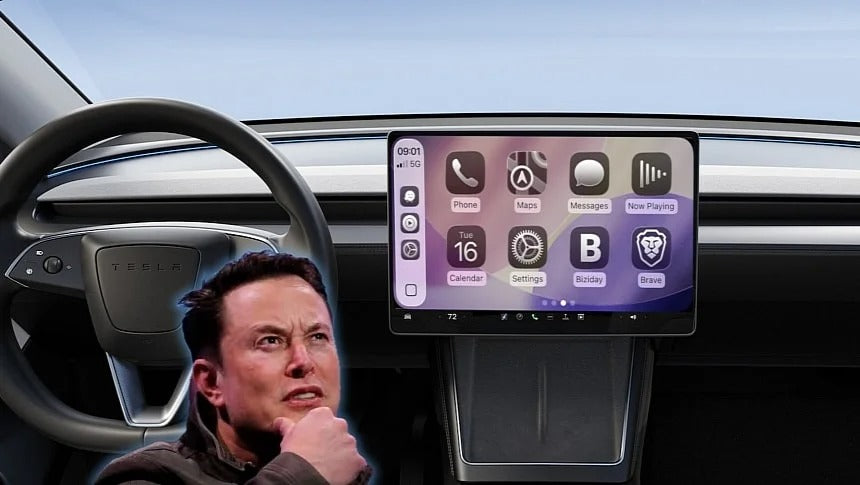
For years, Tesla resisted adding Apple CarPlay to its vehicles. Under the leadership of Elon Musk, the company has consistently prioritized its own infotainment ecosystem over third-party integrations.
But recently, something changed.
Reports suggest Tesla has been actively developing CarPlay integration, reaching advanced testing stages. So why hasn’t it launched yet?
The answer lies not with Tesla—but with Apple’s software ecosystem.
Tesla’s Unique CarPlay Approach
Unlike traditional car manufacturers, Tesla doesn’t want to fully hand over its infotainment system to Apple.
Instead, Tesla’s plan is to:
-
Run CarPlay alongside its native interface
-
Keep Tesla’s built-in navigation and self-driving features active
-
Allow drivers to switch between systems seamlessly
This hybrid approach sounds ideal—on paper.
But in reality, it introduces a major problem.
The Core Issue: Apple Maps vs Tesla Navigation
At the heart of the delay is a conflict between:
-
Apple Maps
-
Tesla’s proprietary navigation system (used for Autopilot and route planning)
Tesla discovered inconsistencies between navigation instructions, especially:
-
Different turn-by-turn directions
-
Varying route calculations
-
Inaccurate guidance in non-US regions
This creates a serious usability issue:
Drivers could see two conflicting navigation instructions on the same screen.
For a brand focused on safety and autonomous driving, this is unacceptable.
Apple Already Fixed the Problem… Kind Of
Tesla reportedly escalated the issue to Apple, which responded quickly.
The fix was implemented—but there’s a catch.
Because CarPlay and Apple Maps are tied to iOS updates, the fix only works on newer versions of iOS 26.
And that’s where things break down.
The Real Problem: iOS Update Adoption
While Apple claims that iOS 26 has been installed on a large percentage of devices, many users are not updating to the latest versions.
Why?
-
Major design changes (like the “Liquid Glass” UI)
-
Performance concerns
-
Users preferring older, stable versions
As a result:
-
Not all drivers have the fix
-
CarPlay navigation remains inconsistent
-
Tesla cannot ensure a reliable experience
So instead of releasing a flawed feature, Tesla chose to delay CarPlay entirely.
Why Tesla Is Waiting (And What It Means)
Tesla’s decision comes down to one thing: control and user experience.
If CarPlay doesn’t work flawlessly for every user, Tesla risks:
-
Driver confusion
-
Safety concerns
-
Negative user feedback
Until iOS adoption becomes more consistent, Tesla is likely to hold back CarPlay integration.
What Tesla Owners Can Do Right Now
If you’re waiting for official CarPlay support in a Tesla, you might be waiting a long time.
Tesla has historically avoided CarPlay, and even now, the rollout is uncertain.
The Alternative: Add CarPlay Yourself
Instead of waiting, many drivers are choosing aftermarket solutions that bring CarPlay to any vehicle—without limitations.
At TheCarPlayer.com, we offer:
-
Wireless CarPlay support
-
Full compatibility with original infotainment systems
-
Advanced features like video streaming (via CANBUS BOX®)
This allows you to enjoy:
-
Apple Maps, Google Maps, and Waze
-
Spotify, WhatsApp, and calls
-
Voice control via Siri
—without depending on manufacturer updates.
Final Thoughts
Tesla’s CarPlay delay highlights a bigger issue:
Modern car features depend not just on the vehicle—but on the smartphone ecosystem behind them.
Until Apple’s updates are widely adopted and fully stable, Tesla will likely continue to wait.
But for drivers who want CarPlay today, the solution is simple:
Upgrade your car—not your patience.
Want Apple CarPlay in Your Car?
Explore our full range of wireless CarPlay modules at TheCarPlayer.com and upgrade your driving experience today.
Share:
How to Install Apple CarPlay in a Ferrari SF90
Apple CarPlay Video Playback Is Coming – Here’s What It Means for Drivers